
How it works —
From an empty unit to a renewed lease, in five moves.
Setup, leasing, the monthly cycle, maintenance, and turnover — every phase of a property's life, drawn out and handed off cleanly. What follows is the whole loop, move by move.
Folio —
no. xxxiv- Moves in the loop
- 04
- Avg. first reply
- < 4 hrs
- Auto-classified
- 92%
- Owner payout
- 5 days
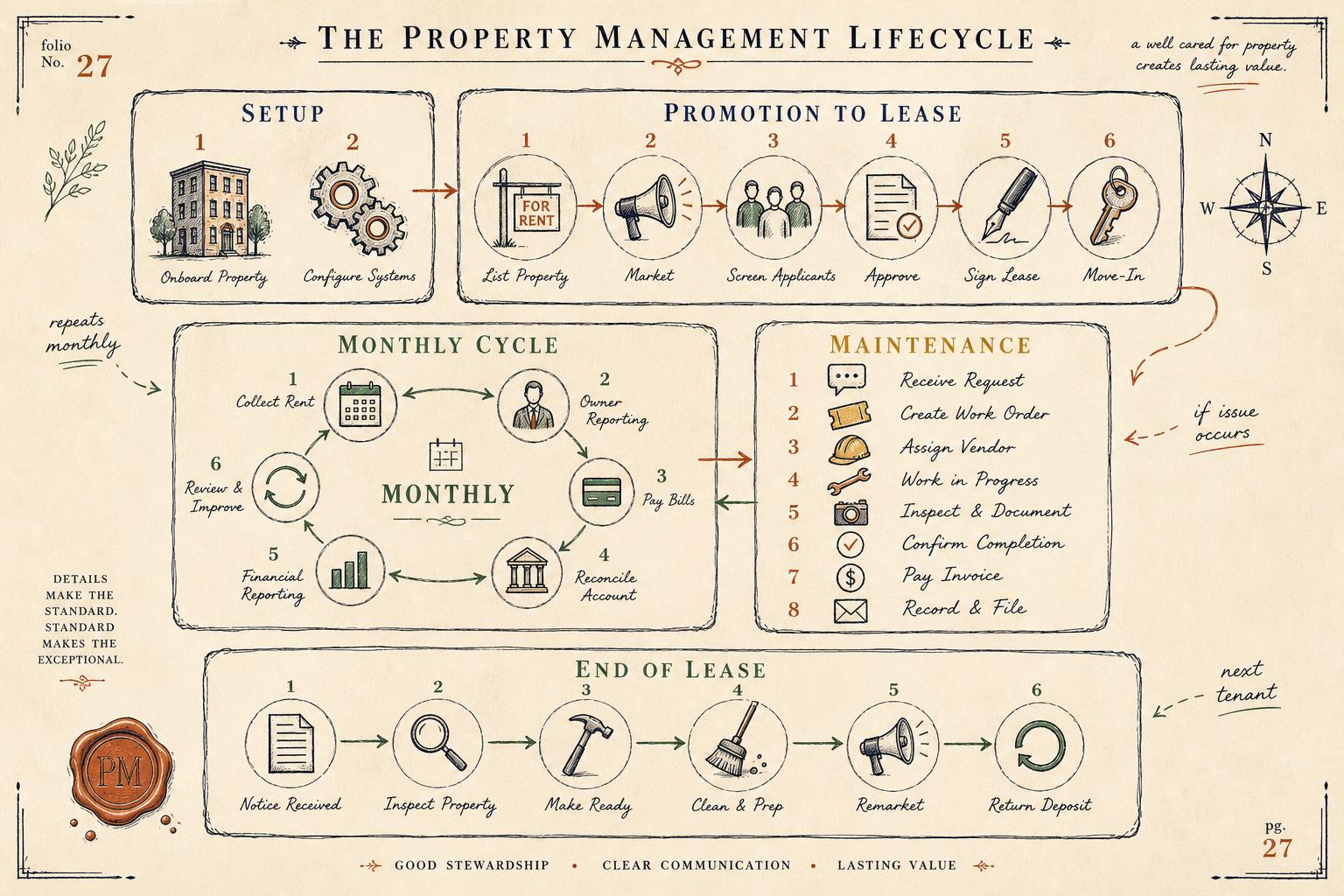
The five moves.
Each card is a phase of the property lifecycle — never a hand-wave. Numbered i to v, in the order they happen.
- iSetup
The property is registered
Building added, units mapped, rent and rules configured. The foundation everything else stands on.
- iiPromotion
A vacancy goes to lease
Listing published, applications received, applicants screened, lease signed, keys handed over — six steps, one clean handover.
- iiiMonthly cycle
Rent runs on its own
Invoice issued, tenant pays, payment processed, owner receives funds, books reconciled — repeated every month, quietly.
- ivMaintenance
Issues are handled in the background
A tenant's note becomes a ticket, the right contractor is dispatched, the work is verified, the invoice is paid — without breaking the rent cycle.
- vTurnover
End of lease feeds the next
Move-out and inspection, repairs and turnover, cleaning and readiness, re-listing — the unit returns to leasing, and the loop begins again.
Anatomy —
The loop, in one circle.
Anatomy of a ticket —
Tuesday, 7:42 p.m. — the sink lets go.
A worked example. Real timestamps, real hand-offs. Names changed, the choreography is not.
- Tue · 7:42 p.m.Tenant
Photo arrives by SMS
“Hey — sink is leaking under the cabinet, getting worse.” One image attached.
from: +1 ••• ••• 4421 · to: Occupello line
— the photo is enough — no forms. —
- Tue · 7:42 p.m.System
Classified · plumbing · urgent
Read, sorted, and routed. A ticket opened against the unit; SLA clock starts.
trade=plumbing · urgency=high · ETA window=2h
- Tue · 7:43 p.m.System
Offered to the right hands
Closest plumber with the strongest history for leaks under cabinets gets first refusal.
offer #1 · expires in 12 min
- Tue · 7:49 p.m.Contractor
Accepted — on the way
Window confirmed with the tenant by SMS, parking instructions attached automatically.
- Tue · 9:11 p.m.Contractor
Job complete with photos
Trap and supply line replaced. Three photos uploaded, before-and-after visible to the owner.
labor 1.2h · parts $34.18
- Wed · 9:02 a.m.Owner
Invoice approved with one tap
Reconciled against the photos and the SLA. Paid by ACH in five business days.
$184.18 · approved by D. Ortiz
By the numbers —
What the loop measures.
92%
Auto-classified
of incoming notes never need a human to triage them.
< 4h
First reply
median time from a tenant's first message to a real response.
1.2
Hand-offs
average per ticket — fewer touches, fewer dropped balls.
5d
Owner payout
from approved invoice to ACH in the contractor's account.
The quiet rules.
An infographic is only honest if the system behind it follows a few small, stubborn rules. Ours.
Offered, not auctioned.
We don't pit hands against each other. The right contractor is offered the work, not asked to bid for it.
Plain language wins.
No tickets you have to translate. No estimates dressed up to confuse. If a tenant can read it, it ships.
Photos beat forms.
An image plus one sentence is enough to start. Forms come later, only if the work needs them.
Paid in days.
Honest invoices are paid quickly. Disputes are surfaced within hours, not buried for weeks.
One owner sign-off.
A single tap to approve. The audit trail (photos, time, parts) is attached automatically.
Quiet by default.
Notifications only when a human decision is actually required. The rest is handled in the background.
Next —